
Tamil Nadu and Kerala Tour
India View full gallery
- Start Chennai
- End Mararikulam
- Meals
- Transport All ground transport and transfers included
- Accommodation 5 star hotels
- Destinations Alappuzha, Kochi, Mararikulam, Chennai, Chettinad, Madurai, Periyar, Puducherry, Thanjavur
- Days 17 days
This exclusive itinerary artfully captures the essence of Southern India, unfolding across two captivating states – Tamil Nadu and Kerala. From the majestic temple cities steeped in centuries-old spiritual tradition to colonial enclaves whispering tales of a bygone era, and onward through lush mountain landscapes and tranquil waterways, this is an immersive voyage into the soul of the South.
Your journey begins in Chennai, a dynamic coastal metropolis that serves as a cultural gateway to Tamil Nadu. Here, colonial-era architecture coexists with vibrant neighbourhoods and sacred spaces centred around ancient temples. The city’s famed Marina Beach, one of the world’s longest urban shorelines, sets a breezy tone for the adventure ahead.
Travelling southward, the UNESCO-listed Mahabalipuram enchants with its monolithic rock-cut temples and the exquisite Shore Temple, a masterpiece of Pallava architecture perched beside the Bay of Bengal. A short drive leads to Pondicherry, a former French enclave whose leafy boulevards, pastel-hued colonial villas and refined cafés evoke the quiet elegance of the Riviera.
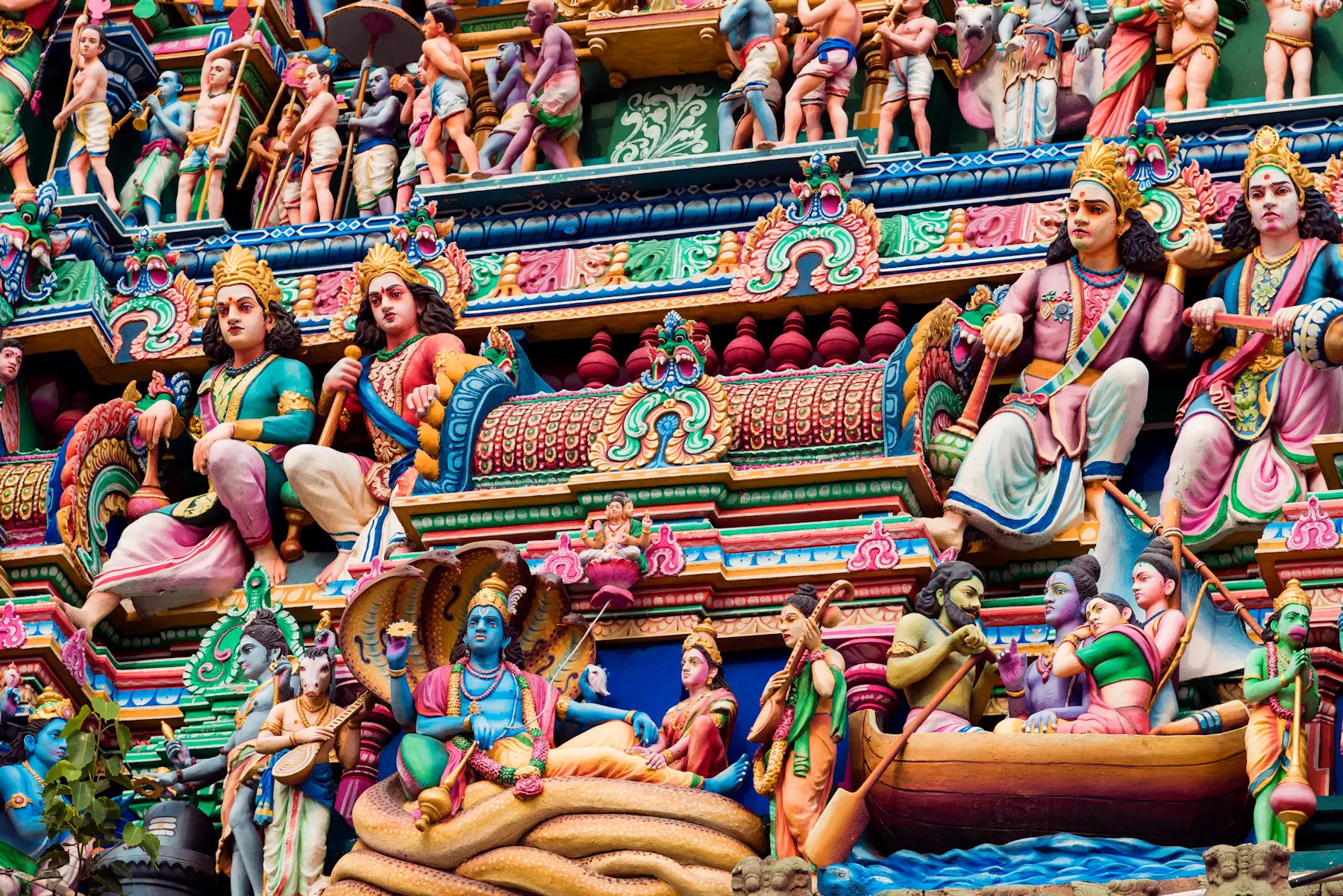
The spiritual heart of Tamil Nadu reveals itself in the monumental temple towns of Thanjavur (Tanjore) and Madurai, whose soaring gopurams (ornamental gateway towers) and labyrinthine sanctuaries are unrivalled in scale and splendour. These living temples remain vital centres of devotion and artistry.
Crossing into the emerald landscapes of Kerala, the air cools as you ascend into the Western Ghats. In the verdant expanse of Periyar National Park, encounter mist-shrouded hills, montane forests and the possibility of glimpsing elephants, exotic birdlife, and even elusive tigers in their natural habitat.
Next, retreat to the serene shores of Vembanad Lake at Kumarakom, where luxury lakeside resorts offer restorative Ayurvedic therapies, yoga, and gourmet Keralan cuisine. Glide through Kerala’s iconic backwaters aboard a private, hand-crafted houseboat—a floating sanctuary amid palm-fringed canals and village life untouched by time.
Your journey concludes in Cochin (Kochi), where the heritage district of Fort Kochi retains its old-world charm. Meander through its storied streets lined with Dutch and Portuguese architecture, spice-laden markets, and contemporary art galleries—a fitting finale to a tour that elegantly weaves together history, spirituality, and natural beauty.
Itinerary
On arrival in Chennai: Having cleared immigration, collected your luggage and passed through customs, please make your way towards the exit of the terminal building where you will see a bank of people waiting for you. Amongst them will be IncluTour representative who will be waiting to greet you with a paging board with your name on.
You are then transferred to your hotel. Check-in as per standard time 1400 hrs.
Afternoon, proceed for tour of Chennai covering the Santhome Cathedral, Fort St. George, Kapaleeshwarar temple etc.
Arulmigu Kapaleeswarar Temple, Mylapore
One of the most revered temples in Tamil Nadu is the Arulmigu Kapaleeswarar Temple, located in Mylapore, a historic neighborhood in the city of Chennai. This is a temple dedicated to Lord Shiva, known here as Arulmigu Kapaleeswarar. His consort is worshipped as Arulmigu Karpagambal.
The temple is renowned for its majestic spire, or gopuram, and is a beautiful example of traditional Dravidian architecture. To the west of the temple lies a large temple tank, adding to the scenic beauty of the surroundings. The temple and tank are encircled by broad streets on all four sides, creating a grand and spacious atmosphere. The overall view of the temple, with its tank and architectural elegance, is truly picturesque.
The Legend Behind the Temple
The name Mylapore is believed to have originated from a legend in which Goddess Uma worshipped Lord Shiva in the form of a peacock—mayil in Tamil. A small shrine located beneath a Punnai tree in the temple courtyard depicts this story in stone, allowing devotees to connect with this sacred legend.
Santhome
Santhome is a locality situated within Mylapore, in the Chennai district of India. The name “Santhome” is derived from Saint Thomas, one of the twelve apostles of Jesus Christ. According to tradition, his tomb lies beneath the San Thome Church, also known as Santhome Cathedral.
This cathedral is a significant religious and historical site, attracting pilgrims and travelers from around the world who come to visit or pray at the tomb of Saint Thomas
Accommodation
5 star hotel
Included Activities
- Arulmigu Kapaleeswarar Temple, Mylapore
- The Legend Behind the Temple
- Santhome
After breakfast you will be driven to Puducherry [approx 160 kms/ 4 hours drive]
En route you will visit Mahabalipuram.
Set by the Bay of Bengal nearly a hundred miles south of Chennai, capital of Tamil Nadu state, Puducherry was among the first places in southern India that saw early colonial powers gain a foothold.
First came the Portuguese in the 1520s followed by the Danes and the Dutch. But it was France that really made its mark in 1674 with the beginnings of a French-style settlement that grew into a town – the heart and largest of Puducherry’s four separate and unconnected districts.
Their rivalry with the British saw ‘Pondy’ (as it’s sometimes referred to affectionately) seized briefly several times but essentially France retained control until 1954. Yet, uniquely in India, a subtle French flavour endures in its architecture, tree-lined streets and cuisine.
Mahabalipuram
The ancient port town of Mahabalipuram is a charming tourist hub which has been attracting travellers for centuries.
It was known already in Marco Polo’s day as the “Seven Pagodas” alluding to the seven tiered towers that once stood on the shore, of which one – the Shore Temple, still stands. The port is famous for its stone carvings, which have World Heritage Site status. Impressive cave temples, monolithic rathas (chariots) and sculpted reliefs built by the Pallavas in the 7th and 8th centuries form this group of monuments.
After sightseeing, enjoy an Indian thali meal or chai tea at one of the bustling diners in town.
Accommodation
5 star hotel
Included Activities
- Mahabalipuram
After breakfast, enjoy the walking tour of Pondicherry.
The walk starts from the Sri Aurobindo Ashram, the white town and the old town.
Later in the day you will visit Auroville.
Sri Aurobindo Ashram
Located in Puducherry, India, Sri Aurobindo Ashram has grown from a small group into a large community. The focus of community life is the Ashram main building which consists of blocks of houses which are adjoined. This is also where Sri Aurobindo and the Mother lived for most of their lives.
Auroville
Located in Puducherry, Auroville is a community that was born on the 28 February 1968.
Its founder created the Auroville Charter which consists of four main ideas, underpinning her vision for Auroville. When Auroville came into being, All India Radio (AIR) broadcast the charter live in 16 languages.
Aurovilians apply the ideas of the Auroville Charter in their daily life, in policy-development, and decisions, big and small. The charter thus forms an omnipresent referent that silently guides the people who choose to live and work for Auroville.
Accommodation
5 star hotel
Included Activities
- Sri Aurobindo Ashram
- Auroville
Breakfast at the hotel.
After breakfast leave Pondicherry for Kumbakonam visiting some of the beautiful temples at Chidambaram, Gangaikondacholapuram and Darasuram (approx. 170 kms / 5 to 6 hrs including stops).
Chidambaram Temple
Chidambaram Temple is a revered Hindu temple dedicated to Lord Shiva, located in the heart of Chidambaram town, Tamil Nadu. Situated 78 km south of Puducherry and 235 km from Chennai, the temple is an architectural marvel with deep historical significance. The Sangam texts mention Viduvelvidugu Perumtaccan, a master architect from the Vishwakarma clan, as leading its renovation. Over the centuries, especially during the Pallava and Chola reigns, the temple saw multiple restorations. Chidambaram is one of the five holiest Shiva temples, each symbolizing a natural element; it represents akasha (ether). The others include Thiruvanaikaval (water), Kanchipuram (earth), Thiruvannamalai (fire), and Kalahasti (air).
Gangaikonda Cholapuram Temple, located in Ariyalur district, houses the largest Shivalingam in India, standing at four meters. The temple complex features five shrines, a lion-shaped well, and intricately carved sculptures.
Darasuram Temple, also known as Airavateswara Temple, was built in the 12th century by Raja Raja Chola II. Famous for its miniature sculptures and elegant columns, it is a UNESCO World Heritage Site and part of the “Great Living Chola Temples.”
Arrive in Kumbakonam and check into your hotel. Spend the rest of the day at your leisure.
Accommodation
5 star hotel
Included Activities
- Chidambaram Temple
- Gangaikonda Cholapuram Temple
- Darasuram Temple
After breakfast, head off on an excursion to Thanjavur visiting Brihadeeswarar Temple and Thanjavur Royal Palace Museum.
Brihadeeswarar Temple
Peruvudaiyar Kovil, which is also famous as Brihadeeswarar Temple, Rajarajeswaram and RajaRajeshwara Temple, is located at Thanjavur in Tamil Nadu state of India. It is one Hindu temple, which they dedicate towards Lord Shiva. It is one luminous example of major heights, which Cholas achieves within Tamil architecture. This temple is one tribute and one reflection of power of its supporter Raja Raja Chola I. this temple remains as India’s largest and Indian architecture’s one of greatest glories. It is also a part of UNESCO World Heritage Site as “Great Living Chola Temples”.
This great temple is India’s one of most prized site for its architecture. It stands in middle of fortified walls added probably in sixteenth century. There is one temple tower, which people call as Vimana. It is 216 feet or 66 meters high. It is also one among tallest tower in whole world in its kind. Kumbam, Chikharam or Kalasha, which is bulbous, or apex structure on top of temple, people believe that it is made out of a single stone carving.
Thanjavur Royal Palace Museum
The Thanjavur Maratha Palace Complex, known locally as Aranmanai, is the official residence of the Bhonsle family who ruled over the Tanjore region from 1674 to 1855. The original name of Thanjavur Palace is Sivaganga Fort, which is rarely used these days. A remarkable collection of South Indian sculptures and paintings is housed in the old palace buildings at Thanjavur (Tanjore).
Today, the town is a flourishing centre for bronze sculpture, stonework and paintings. The palace was originally built by the Nayak rulers of Tamil Nadu. It was this dynasty that added to and enlarged many of the temples, with ornate and often huge sculptures.
The palace building, set within a large compound, also contains the Saraswati Library and the Sangeetha Sabha, or Music Hall. This museum is best known for its bronze sculpture collection, of rare artistic quality.
Accommodation
5 star hotel
Meals
Breakfast
Included Activities
- Brihadeeswarar Temple
- Thanjavur Royal Palace Museum
Situated in the heart of Tamil Nadu state in India, the region of Chettinad is well-known for its agriculture, architecture, and unique cuisine. This region holds important cultural and historical treasures including French Art-Deco style palatial mansions peppered across the region, the magnificent Raja’s palace in Kanadukathan, and the 17th-century hilltop Thirumayam Fort.
Browse antique markets in Karaikudi, sample the region’s flavourful and fiery cuisine featuring the famous Chettinad chicken, and visit to one of the impressively ornate temples. The town is also famous for its beautiful, hand-printed cotton fabric and traditional brightly-coloured Athangudi tiles.
Morning visit Trichy and later leave for Karaikudi (Chettinad)
The most famous landmark in Tiruchirappalli is the Rockfort Temple, also known as Ucchi Pillaiyar Kovil. Located in the heart of the city, the temple sits atop a massive rock formation that rises 275 feet above the surrounding landscape. It is accessed by climbing 437 steps carved directly into the rock.
Midway up the climb is the Sri Thayumanaswamy Temple, dedicated to Lord Shiva. This temple features a majestic 100-pillared hall and a beautifully crafted vimana (tower above the sanctum). Inscriptions found within the temple date back to the 3rd century B.C., highlighting its historical and cultural significance.
Check in on arrival at Karaikudi/Chettinad.
Later explore the village, interact with the local people.
Accommodation
5 star hotel
Included Activities
- Rockfort Temple
- Sri Thayumanaswamy Temple
After breakfast, enjoy sightseeing tour of the city Chettinad, visiting Chettinad mansions, tile making demonstration.
Later you will be driven to Madurai. Arrive Madurai and check in at the hotel.
Rest of the day at leisure.
Few cities in south India are as compelling – and none quite so ancient – as Madurai. Tamil Nadu’s cultural capital has a recorded history dating back at least 2500 years; for around a millennia it was the Pandyan dynasty’s capital and was trading with ancient Rome and China.
These days the city is famed above all else for its enormous Sri Meenakshi-Sundareshwarar temple, still one of India’s largest temple complexes with spectacular towered gateways and a seemingly endless cycle of worship and rituals servicing thousands of pilgrims each day. This makes Madurai a key destination for travellers to south India.
Accommodation
5 star hotel
Meals
Breakfast
Included Activities
- Tour of Chettinad
- Visit Chettinad mansions
- Tile making demonstration
Morning sightseeing tour of Madurai.
After breakfast proceed for a city tour of Madurai visit Meenakshi Temple, Thirumalai Nayak Palace and Gandhi Memorial Museum.
Meenakshi Temple
The Meenakshi Amman Temple is a historic Hindu temple situated on the southern bank of the Vaigai River in the temple city of Madurai, Tamil Nadu, India. It is dedicated to the goddess Parvati, worshipped here as Meenakshi, and her consort Shiva, known in this temple as Sundareswarar. The temple forms the heart and lifeline of Madurai, a city with a history spanning over 2,500 years. It holds deep cultural and religious significance for the Tamil people and has been mentioned in Tamil literature since ancient times, although the current structure was built between 1623 and 1655 CE.
The temple features 14 gopurams (gateway towers), ranging from 45 to 50 meters in height, with the tallest being the southern tower at 51.9 meters (170 feet). It also includes two golden sculpted vimanas (tower-like structures) above the sanctums (garbhagrihas) of the main deities. The temple attracts approximately 15,000 visitors daily, increasing to around 25,000 on Fridays, and generates an annual revenue of about 60 million INR. It is estimated to house around 33,000 sculptures. The temple was listed among the top 30 nominees for the “New Seven Wonders of the World.”
One of its major events is the 10-day Meenakshi Tirukalyanam festival, held in April or May, which draws over a million visitors.
Thirumalai Nayak Palace
Thirumalai Nayak Palace is a stunning example of Indo-Saracenic architecture, built in 1636 AD by King Thirumalai Nayak. Designed by an Italian architect, the palace once served as the royal residence and is located just 2.5 kilometers from the Meenakshi Temple in Madurai.
The palace is divided into two main sections: Swargavilasa and Rangavilasa. These included various parts such as the royal residence, a theater, shrine, apartments, armory, palanquin storage area, royal bandstand, servants’ quarters, pond, and garden. During his reign, King Thirumalai Nayak hosted daily music and dance performances within the palace, and each morning, he would offer prayers to Goddess Rajarajeshwari at the palace shrine, which is intricately carved in stone and once had a dome covered in gold.
Unfortunately, the palace was later partially destroyed by his grandson, Chokkanatha Nayak, who repurposed many of its materials to construct his own palace. The original palace complex was four times larger than the structure that remains today.
Gandhi Memorial Museum
The Gandhi Memorial Museum in Madurai offers more than just insights into the life and philosophy of Mahatma Gandhi—it also holds considerable historical significance. The museum houses rare photographs, letters, and artifacts associated with India’s freedom struggle, serving as a vital reminder of Gandhi’s enduring legacy and his connection to Tamil Nadu.
Rest of the day at leisure.
Accommodation
5 star hotel
Meals
Breakfast
Included Activities
- Meenakshi Temple
- Thirumalai Nayak Palace
- Gandhi Memorial Museum
After breakfast leave Madurai for Thekkady (approx. 4 hrs).
Check in on arrival at the hotel.
Later in the day visit Spice Plantation.
The trip covers spice plantations such as cardamom, pepper, vanilla, clove, cinnamon, nutmeg, ayurvedic herbs etc. Over twelve varieties of spices including ginger, garlic, cardamom, vannilla, pepper, cinnamon, coffee, tea, clove and nutmeg is cultivated in Thekkady and its neighbouring villages.
Periyar National Park
Nestled high in the evocatively named Cardamom Hills near the Tamil Nadu–Kerala border, Periyar National Park is renowned for its lush, forested hills, montane grasslands, temperate climate, and rich biodiversity, including many endemic species. This region is home to some of southern India’s highest peaks, with elevations exceeding 6,500 feet, and serves as the watershed for two of Kerala’s major rivers.
At the heart of the park lies Periyar Lake—a sprawling, intricately shaped body of water covering 31 square kilometers. It was formed in the 1890s following the construction of the Mullaperiyar Dam. While nearly 2,000 species of flowering plants, including 140 types of orchids, flourish here, it’s the towering forests of teak, sandalwood, banyan, and bamboo that provide a striking backdrop for the park’s diverse wildlife.
Periyar is famous for its elephants and tigers, but it also shelters a wide variety of mammals such as sloth bears, Indian bison, flying squirrels, jungle cats, and wild dogs. Bird enthusiasts will find plenty to admire among the approximately 270 bird species recorded here, including hornbills, flycatchers, and storks.
Nearby attractions include the picturesque Chellarkovil Waterfalls, especially impressive during the monsoon season, and Pandikuzhi, a scenic viewpoint offering panoramic views of the surrounding hills. Just north of the park in the town of Kumily, the Kadathanadan Kalari Centre hosts cultural performances featuring Kathakali, Kerala’s traditional dance-drama, and Kalaripayattu, one of the world’s oldest martial arts.
Accommodation
5 star hotel
Meals
Breakfast
Included Activities
- Spice plantation
Morning: Nature Walk in Periyar National Park
After an early breakfast, set out for a guided Nature Walk in Periyar National Park. These treks follow various trails, typically 4 to 5 km long, winding through a rich mosaic of evergreen and moist deciduous forests, as well as marshy grasslands. The walk offers a wonderful opportunity to observe the region’s flora and fauna up close, listen to the sounds of the forest, and immerse yourself in the serenity of nature.
Nature Walk sessions are available between 7:00 AM and 10:30 AM, and again between 2:00 PM and 3:00 PM, with each walk lasting approximately three hours. Each group, limited to a maximum of five participants, is led by a trained tribal guide who shares deep insights into the forest ecosystem. This experience is ideal for those who wish to connect with nature in its purest form.
Afternoon: Spice Plantation Tour
Later in the afternoon, enjoy a guided tour of the region’s famed spice plantations. Learn about the cultivation and processing of spices like cardamom, pepper, cinnamon, and cloves—an essential part of Kerala’s agricultural and culinary heritage.
Evening: Kalaripayattu Martial Arts Show
In the evening, witness a live performance of Kalaripayattu, one of the oldest martial art forms in the world. Considered the mother of all martial arts, Kalaripayattu is believed to date back over 3,000 years and is traditionally attributed to the sage Parasurama, who is said to have reclaimed Kerala from the Arabian Sea.
This ancient art, which originated in South India, combines physical agility, weapon training, and meditative discipline. Fascinatingly, Kung Fu, popularized by the Shaolin monks, traces its roots to Bodhidharma, an Indian Buddhist monk and Kalaripayattu master. The performance offers a powerful glimpse into Kerala’s martial heritage and spiritual philosophy.
Accommodation
5 star hotel
Meals
Breakfast
Included Activities
- Nature Walk in Periyar National Park
- Spice Plantation tour
- Kalaripayattu Martial Arts Show
Morning you will be driven to Kochi (approx. 4½ hrs). On arrival check in at the hotel.
Rest of the day at leisure to explore the Fort Kochi area on own.
A major hub for the spice trade since the 14th century, Kochi (formerly Cochin) is Kerala’s largest city and a must-visit destination for anyone travelling through southern India. Over the centuries, it has welcomed a diverse array of traders—from Arabs, Portuguese, and Greeks to Chinese merchants—and was once home to India’s oldest Jewish community.
Spread across a collection of islands, a peninsula, and part of the mainland, Kochi uniquely blends land and water. Its layout means that exploring the city often involves crossing bridges or traveling by ferry and water taxi—an experience that sets it apart from most Indian cities.
The heart of Kochi’s historic charm lies in Fort Kochi. Here, you’ll find some of the city’s most iconic landmarks, including the Church of St. Francis, built in 1503 and recognised as one of the oldest European churches in India. It once held the remains of Portuguese explorer Vasco da Gama before they were returned to Lisbon. Nearby, the 16th-century Mattancherry Palace (also known as the Dutch Palace) houses a remarkable collection of medieval murals, many depicting scenes from the Indian epics—the Ramayana and the Mahabharata.
Accommodation
5 star hotel
Meals
Breakfast
After breakfast visit of Fort Kochi, Dutch Palace, Jewish Synagogue and St Francis Church.
Fort Kochi
Fort Kochi derives its name from a now-vanished fort built by the Portuguese during their colonial rule. Over the centuries, it passed through the hands of the Dutch and then the British, each leaving behind distinct architectural and cultural influences. Today, Fort Kochi is a vibrant blend of history and heritage, with winding streets, colonial-era buildings, and a multicultural atmosphere that reflects its rich past.
The best way to explore Fort Kochi is on foot. Walking tours are widely available and take visitors through key landmarks such as:
-
Santa Cruz Basilica
-
Cochin Bishop’s House
-
The Dutch Cemetery
-
The Parade Ground
-
St. Francis Church (India’s oldest European church)
-
Indo-Portuguese Museum
Alternatively, you can explore at your own pace with a self-guided walking tour using a local map.
Jew Town
Located near Mattancherry, Jew Town traces its roots to 1492, when Sephardic Jews arrived in Kochi after being expelled from the Iberian Peninsula. More refugees arrived in 1524, welcomed by the Raja of Cochin, who granted them land adjacent to his palace. By 1568, the Paradesi Synagogue was built, forming the heart of the Jewish settlement. Jew Town developed around it and remains one of the most atmospheric quarters in Kochi, filled with antique shops, spice markets, and heritage buildings.
Jewish Synagogue (Paradesi Synagogue)
The Paradesi Synagogue is the oldest active synagogue in India, dating back to 1568. Inside, visitors are greeted by a stunning array of:
-
Belgian crystal chandeliers
-
Blue and white Chinese willow-patterned floor tiles
-
Brass-railed pulpit
-
Scrolls of the Torah
-
Gold crowns gifted by patrons
One of the synagogue’s most historically significant artifacts is a set of copper plates, inscribed in ancient Tamil, which detail the privileges granted to Joseph Rabban, an early Jewish leader, by a ruler of the Malabar Coast in the 10th century.
Dutch Palace (Mattancherry Palace)
Originally built by the Portuguese and later renovated and gifted to the Raja of Kochi by the Dutch in the 17th century, the Dutch Palace is a fine example of colonial architecture blended with traditional Kerala style. The palace is most famous for its extraordinary mural paintings, which vividly depict scenes from the Ramayana and Mahabharata. The palace also houses exhibits of royal regalia and portraits of the Kochi royal family.
Chinese Fishing Nets
End your tour with a visit to the iconic Chinese Fishing Nets, unique to the Kochi coastline. Known locally as cheena vala, these large, cantilevered nets are operated from the shore and are believed to have been introduced by Chinese traders in the 14th century. Watching them in action—especially at sunset—is a quintessential Kochi experience.
Accommodation
5 star hotel
Meals
Breakfast
Included Activities
- Fort Kochi
- Dutch Palace
- Jewish Synagogue
- St Francis Church
After breakfast, leave Kochi for Alleppey (approx. 2 hrs) – reach Alleppey by Noon and board the Houseboat for an overnight cruise on the backwaters.
Cruise over the backwaters enjoying the narrow canals and visiting the local villages.
NOTE:
- Check in time: 12.30 pm, Check out time: 9.30 am.
- Air conditioner in Deluxe Houseboat bedrooms will be ON only from 9 pm to 7 am.
Located in the Indian state of Kerala, the bustling city of Alappuzha, also known as Alleppey, is set along the coast of the beautiful Laccadive Sea. Dubbed the ‘Venice of the East’, it is renowned for its sublime houseboat cruises which float along the tranquil canals of Kerala.
Alappuzha is also said to be one of the most beloved tourist centres in the state. While cruising the palm-shaded canals is the most popular thing to do, visitors can also enjoy visiting Alappuzha’s beautiful beaches, exploring the little riverside villages dotting the lush countryside and discovering an array of resplendent temples.
Don’t miss the annual Nehru Trophy Boat Race held at Punnamada Lake.
Accommodation
Luxury houseboat
Meals
Breakfast
After breakfast, disembark the houseboat and drive to Marari hotel [approx. 1 hrs drive]
On arrival in Marari, check in to hotel.
Rest of the day at leisure.
Situated only 40 km from the city of Cochin, in the Alappuzha district of Kerala, Mararikulam is a charming little coastal village known for its pristine sand beaches, swinging coconut palms, and quiet, laidback atmosphere.
The village has managed to avoid the mass development associated with many of the other beach towns in the area resulting in an untouched natural environment dotted with only a handful of small resorts.
The main attraction here is the exquisite Marari beach where you will find fishermen heading out daily to explore the Malabar coast, much as their ancestors have done for generations.
Accommodation
5 star hotel
Meals
Breakfast
Breakfast at the hotel.
These days are at leisure with beach activities, yoga/mediation or to rejuvenate with some Ayurveda massages (on direct payment).
Accommodation
5 star hotel
Meals
Breakfast
You will be met & transferred to Cochin airport (approx. 2½ hrs) to board your flight for onward journey.
Gallery